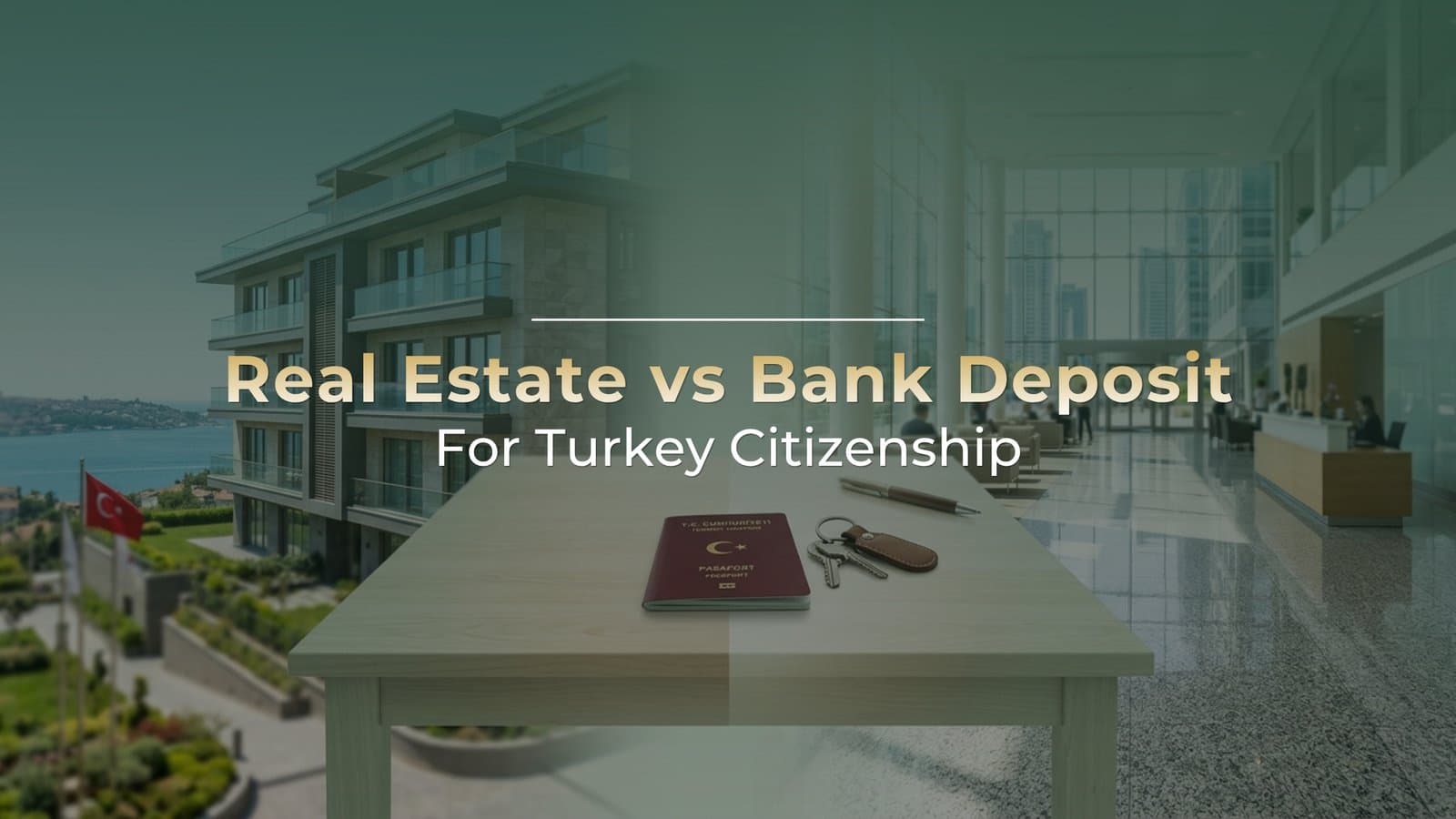
Real Estate vs. Bank Deposit for Turkey Citizenship
شائع ہوا:·8 منٹ کا مطالعہ
Introduction: Two Paths to a Turkish Passport
Turkey’s Citizenship by Investment (CBI) program, launched in 2017, has emerged as one of the world’s most competitive and accessible second-passport programs. Foreign nationals who meet the qualifying investment threshold receive full Turkish citizenship — including passport rights — for themselves and their immediate families, with no language tests, residency requirements, or complex interviews.
In 2026, two routes dominate the conversation among investors: purchasing real estate or placing a bank deposit in a Turkish financial institution. Both pathways lead to the same outcome — a Turkish passport — but they differ significantly in terms of cost, financial return, risk profile, and long-term value.
This guide breaks down both options using the latest 2026 data, so you can make a confident, informed decision about which route is right for you.
Turkey Citizenship by Investment: 2026 Program Overview
Turkey’s CBI program grants Turkish nationality to foreign investors who commit to a qualifying financial investment for a minimum of three years. Since its launch, the program has drawn applicants from over 100 countries — especially from the Middle East, South Asia, Central Asia, Europe, and North America —owing to its fast processing, family inclusion, and low barrier to entry compared to European alternatives.
Key Program Facts (2026)
Minimum real estate investment: $400,000 USD
Minimum bank deposit: $500,000 USD
Holding period for both routes: 3 years
Citizenship is permanent — even after the investment is sold or withdrawn
Spouse and children under 18 included at no additional investment cost
No residency requirement before or after approval
No language test or cultural integration exam required
Turkish passport: visa-free or visa-on-arrival access to 110+ countries including Japan, South Korea, Singapore, and Qatar
Option 1: Real Estate Investment — The Preferred Route
Real estate remains by far the most popular pathway to Turkish citizenship in 2026. It is the only CBI route that combines citizenship eligibility with tangible asset ownership, rental income potential, and long-term capital appreciation.
How It Works
The applicant purchases one or more residential or commercial properties with a combined government-appraised value of at least $400,000 USD. The properties must be:
Purchased from a Turkish seller (not a relative)
Officially appraised by an SPK-licensed valuator
Paid via international bank transfer (documented)
Registered under the investor’s name with a 3-year sale restriction annotation on the title deed (TAPU)
Free of outstanding debts or encumbrances at the time of purchase
After three years, the annotation is automatically removed and the investor may sell freely — without any impact on citizenship status. The citizenship is permanent.
Financial Returns: The Real Estate Advantage
Unlike the bank deposit route, real estate investment in Turkey generates active financial returns during the mandatory 3-year holding period. Here is what the current data shows:
*Based on $400,000 investment at 7.32% gross annual yield over 3 years. Net yield typically 1.5–2% lower after taxes, fees, and vacancy.
Rental Yields: According to Global Property Guide data (Q1 2026), the average gross rental yield in Turkey stands at 7.32%, with Istanbul delivering an even stronger 8.17%. These figures outperform most European markets, which average 3%–5% gross.
Capital Appreciation: Investropa’s 2026 forecast projects an average nominal appreciation rate of 17–25% per year for Istanbul property over the next five years, driven by falling interest rates, sustained urban demand, and limited new supply in prime districts.
5-Year Total Return: Analysts project a cumulative 5-year total return of approximately 100–120% for well-selected mid-market Istanbul apartments, combining capital growth (75–80%) and net rental income (20–40%).
VAT Exemption: Foreign buyers purchasing new-build properties in Turkey are exempt from the 18% VAT, providing an immediate additional saving on qualifying transactions.
Top Investment Locations in Turkey (2026)
Istanbul (Atasehir, Pendik, Kartal, Umraniye) — highest liquidity, strongest yield and appreciation outlook
Antalya — lifestyle destination with strong short-term rental demand; 6.14% gross yield
Ankara — fastest annual price growth of major cities (+38.69% YoY in late 2025)
Izmir — lower entry prices with 5–8% gross yields; growing expat base
Bodrum & Alanya — premium coastal markets; 8–12% long-term rental yields
Option 2: Bank Deposit — The Financial Route
The bank deposit route offers a simpler, less hands-on pathway to Turkish citizenship. It appeals to investors who prefer a purely financial instrument over real property ownership.
How It Works
The applicant deposits a minimum of $500,000 USD (or equivalent in foreign currency or Turkish lira) into an account held at a Turkish bank. The deposit must be:
Maintained for a minimum of 3 years without withdrawal
Confirmed by a letter from the bank and verified by the Banking Regulation and Supervision Agency (BDDK)
Supplemented by a Conformity Certificate from the Ministry of Treasury and Finance
After 3 years, the full deposit amount can be withdrawn, with no impact on citizenship status.
Financial Profile of the Bank Deposit Route
The bank deposit generates interest income in Turkish lira terms, though the rate of return and currency dynamics deserve close examination:
Higher minimum: $500,000 — that is $100,000 more than the real estate threshold
Interest income: Turkish policy rate entered 2026 at 38% (following a December 2025 cut), meaning TRY-denominated deposits can yield high nominal rates — but real purchasing power is eroded by inflation
Currency risk: TRY deposits are directly exposed to lira depreciation against USD, EUR, and other hard currencies
No physical asset: Unlike real estate, the deposit generates no tangible asset, no rental income in hard currency, and no capital appreciation
Liquidity locked: The full amount is frozen for 3 years, offering no partial access
Side-by-Side Comparison: Real Estate vs. Bank Deposit (2026)
The table below provides a comprehensive comparison of both citizenship pathways across all critical investment criteria:
Which Option Is Better for You? An Honest Assessment
The answer depends on your investment objectives, risk appetite, and long-term goals. Here is a straightforward breakdown:
Choose Real Estate If You:
Want to maximize financial return during the 3-year holding period
Are comfortable managing or outsourcing property rental operations
Wish to hold a tangible USD-valued asset as part of your portfolio
Plan to use the property personally (residence, holiday home, or family use)
Want to hedge against Turkish lira depreciation through USD-denominated property
Are investing the minimum ($400,000) and want to preserve as much capital as possible
Choose Bank Deposit If You:
Prefer a straightforward, hands-off financial instrument
Have $500,000+ available and want administrative simplicity
Are not interested in property management responsibilities
Have limited time to spend on due diligence for property selection
The Application Process: Step by Step
Regardless of the investment route chosen, the Turkish CBI application follows a structured process. Here is an overview of the key stages:
Step 1 — Investment Selection: Choose and complete the qualifying investment (property purchase or bank deposit). Ensure all documentation meets government standards.
Step 2 — Residence Permit Application: Apply for a short-term residence permit in Turkey. Biometrics and a digital photograph are required in person.
Step 3 — Open a Turkish Bank Account: Required for all applicants to facilitate transparent financial transactions.
Step 4 — Submit Citizenship Application: The main applicant and spouse must appear in person at the migration office. All documents are reviewed at this stage.
Step 5 — Due Diligence Review: The government conducts a background check, typically taking 3–4 months.
Step 6 — Citizenship Certificate & Passport Issuance: Upon approval, citizenship certificates are issued, followed by Turkish passport issuance within 1–2 weeks.
Total timeline: Most well-prepared applications are completed within 3-6 months from the date of investment.
Frequently Asked Questions (2026)
1- Can I combine multiple properties to meet the $400,000 threshold?
Yes. Investors may combine multiple residential or commercial properties, provided each is registered in the applicant’s name and the total officially appraised value meets or exceeds $400,000 USD.
2- Can I rent out the property during the 3-year holding period?
Absolutely. Investors are fully entitled to rent out their property and collect rental income throughout the mandatory holding period. The only restriction is that the property cannot be sold or transferred within the first 3 years.
3- Is my original citizenship affected?
No. Turkey allows dual citizenship. Obtaining Turkish nationality does not require renouncing your existing passport or citizenship.
4- What happens to my citizenship if I sell the property after 3 years?
Turkish citizenship is permanent once granted. Selling the property after the 3-year holding period has no impact whatsoever on your citizenship status or your family’s status.
5- Are off-plan properties eligible?
Yes, provided the development project is approved, payments are made officially through a Turkish bank, and the purchase contract is notarized. Off-plan purchases can offer lower entry prices and strong appreciation potential.
6- Can my children over 18 be included in my application?
Only dependent children under the age of 18 may be included in the primary investor’s application. Adult children over 18 would require their own qualifying investment of $400,000.
7- Will investment thresholds increase in 2026?
The current thresholds ($400,000 for real estate; $500,000 for bank deposits) remain in effect as of May 2026. Some market analysts predict a future increase given sustained demand, so acting sooner is advisable. Multi Mulk monitors all regulatory updates and will proactively inform clients of any changes.
Conclusion: Real Estate Wins on Value — But Know Your Goals
Both real estate investment and bank deposits provide a clear, government-backed route to Turkish citizenship. However, the financial data for 2026 tells a compelling story: real estate investment delivers more for less.
At the lower minimum of $400,000, real estate investors gain not only citizenship but also a tangible, income-generating, appreciating asset — with average gross rental yields of 7.32% nationally and projected nominal price appreciation of 17–25% per year in Istanbul. The bank deposit route, at $500,000, is simpler but generates no asset and carries meaningful currency risk.
For investors seeking genuine long-term value alongside their Turkish passport, real estate is the clear frontrunner. And with a trusted partner like Multi Mulk guiding every step of the process, the journey from investor to citizen is smoother, safer, and more rewarding.
Get in touch!
| Criteria | 🏠 Real Estate Investment | 🏦 Bank Deposit |
|---|---|---|
| Investment Type | Real Estate Purchase | Bank Deposit (Turkish Bank) |
| Minimum Amount | $400,000 USD | $500,000 USD (+$100K more) |
| Citizenship Eligibility | ✔ Yes | ✔ Yes |
| Holding Period | 3 years (then free to sell) | 3 years (locked in bank) |
| Asset Tangibility | Physical asset you own | Cash deposit, no asset |
| Rental Income | ~7.32% gross yield (Q1 2026) | None |
| Capital Appreciation | 17–25% nominal/yr (5-yr fcst) | None |
| Investment Recoverable? | Yes – sell after 3 years | Yes – withdraw after 3 years |
| Currency Risk Hedge | USD-valued property buffers TRY | TRY deposit exposed to lira |
| Personal/Family Use | Live, holiday, or rent out | N/A |
| Portfolio Diversification | Real asset + income stream | Liquid financial asset only |
| VAT for Foreign Buyers | 18% VAT exemption on new-builds | N/A |
| Processing Time | ~3- 6 months average | ~3- 6 months average |
| Who Prefers This? | Investors seeking ROI + lifestyle | Investors preferring simplicity |