
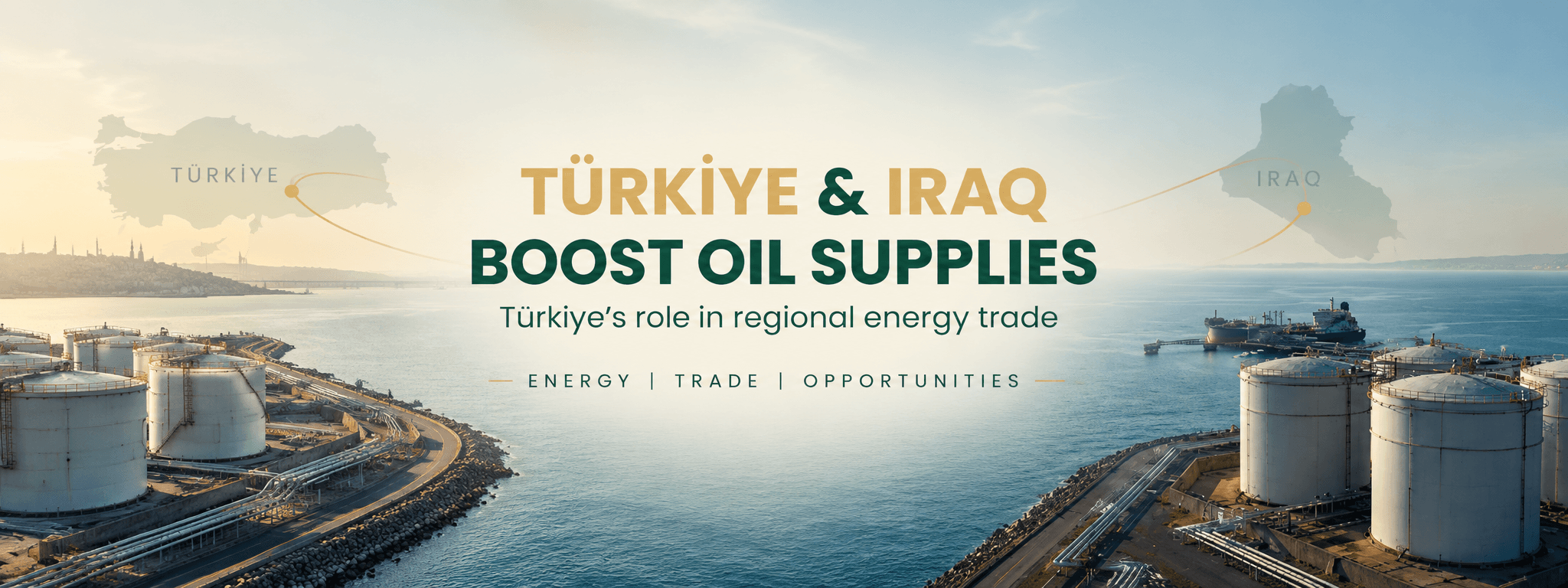
Türkiye and Iraq Boost Oil Supplies Through Ceyhan: What It Means for Türkiye's Energy Hub Ambitions
ByAlireza·Published on:Last reviewed·7 min read
Türkiye and Iraq are deepening their energy cooperation through the Iraq–Türkiye Crude Oil Pipeline, with Ceyhan on Türkiye's Mediterranean coast positioned to play a larger role in moving Iraqi oil to international markets.
On August 1, 2026, the two countries signed a one-year agreement covering crude oil transportation through the pipeline to Ceyhan. The agreement envisages shipments of at least 750,000 barrels per day, while Iraqi officials have indicated an ambition to eventually increase exports through Türkiye toward 1 million barrels per day.
The development matters beyond the volume of oil involved. As geopolitical and shipping risks surrounding the Strait of Hormuz encourage oil-producing countries to examine alternative export routes, Ceyhan could become increasingly important in connecting Middle Eastern energy supplies with Mediterranean and global markets.
What Is the Iraq–Türkiye Oil Agreement?
The agreement signed on August 1 allows Iraqi crude to continue moving through the Iraq–Türkiye Crude Oil Pipeline to the Mediterranean port of Ceyhan.
Türkiye's BOTAŞ and Iraq's State Organization for Marketing of Oil (SOMO) and North Oil Company (NOC) signed the arrangement following talks between the two governments. The current agreement runs for one year while Ankara and Baghdad work toward a broader, longer-term framework for energy cooperation.
Iraqi Prime Minister Ali al-Zaidi described the agreement as an important strategic step for maintaining oil exports and strengthening economic cooperation between the neighboring countries.
However, the 750,000-barrel figure should be understood as a target under the new arrangement rather than evidence that this volume is already flowing every day. Reports in August indicated that actual northern exports remained considerably below that level because of production and supply constraints.
That distinction is important when assessing the immediate economic impact of the agreement.
Why Could Ceyhan Become More Important?
Ceyhan is already one of Türkiye's most strategically located energy centers. Situated on the Mediterranean coast, it receives crude through major pipeline systems and provides direct access to international shipping routes.
Its significance could increase as oil producers look for ways to diversify their export infrastructure.
A substantial share of Middle Eastern energy exports traditionally travels through the Strait of Hormuz. Recent disruptions and geopolitical risks have highlighted the vulnerability that can result when major producers depend heavily on a limited number of maritime corridors. Iraq is therefore examining additional export options through Türkiye, Syria and Jordan.
Ceyhan offers Iraq an important advantage: access to the Mediterranean without requiring crude transported through Türkiye to pass through the Strait of Hormuz.
Türkiye, meanwhile, gains an opportunity to increase the utilization and strategic relevance of its existing energy infrastructure.
Could Iraq Increase Oil Exports Through Türkiye to 1 Million Barrels per Day?
Iraq wants to eventually increase crude exports through Türkiye toward 1 million barrels per day, although achieving this level will depend on production, infrastructure and operational conditions.
Kirkuk Governor Mohammed Agha said Iraq aims to increase exports through Türkiye to one million barrels per day as the production capacity of Kirkuk fields expands.
The longer-term opportunity is significant because the Iraq–Türkiye pipeline system has considerable technical capacity. Anadolu Agency reported that the infrastructure has an estimated technical capacity of around 1.5 million barrels per day, meaning greater utilization could potentially be possible if sufficient crude supplies, infrastructure and commercial arrangements are available.
The one-million-barrel objective should therefore be viewed as a strategic target rather than a guaranteed near-term export volume.
TPAO Is Expanding Türkiye's Role in Iraqi Oil Production
Türkiye's involvement in Iraq is also moving beyond simply transporting crude.
The Turkish Petroleum Corporation (TPAO) has acquired a 15% stake in a consortium involving bp and ConocoPhillips that is working on the development of major oil fields in Kirkuk.
The partnership covers fields including the Baba and Avanah domes as well as Bai Hassan, Jambur and Khabbaz. According to publicly available field-level information cited by Anadolu Agency, these assets were producing approximately 300,000 barrels per day when the partnership was reported.
This represents an important evolution in Türkiye–Iraq energy relations.
Instead of Türkiye functioning primarily as a transit country for Iraqi crude, TPAO's participation gives the country exposure to the upstream side of the energy value chain — the exploration, development and production of oil itself.
That could create a deeper and more strategically integrated relationship between the two countries.
What Could This Mean for Türkiye's Regional Energy Strategy?
Türkiye has long benefited from its geographic position between major oil and gas-producing regions and large consumer markets in Europe and the Mediterranean.
The latest Iraq agreement could strengthen that advantage.
If Iraqi production expands and larger volumes move through Ceyhan, Türkiye could potentially increase its role across several parts of the energy value chain, including:
- Pipeline transportation
- Oil storage
- Port and terminal operations
- Refining and petroleum-product logistics
- Energy trading
- Upstream production partnerships
Türkiye's Energy and Natural Resources Minister Alparslan Bayraktar has previously discussed an ambition to develop Ceyhan into a major oil and petroleum-products center comparable in function to established international trading hubs.
Achieving such an ambition would require more than higher pipeline volumes. Reliable supply agreements, storage capacity, international market participation, pricing mechanisms, regulatory stability and further infrastructure investment would all be important.
Nevertheless, increasing Iraqi flows would strengthen the commercial foundation on which a larger Ceyhan energy ecosystem could develop.
Why Does This Matter for Investors Following Türkiye?
Energy infrastructure developments can provide useful context for international investors evaluating Türkiye's broader economic direction.
A stronger Ceyhan corridor could support infrastructure investment, logistics activity, port services and commercial links between Türkiye, Iraq and international markets. It could also reinforce Türkiye's strategic relevance within regional supply chains.
For investors following sectors such as infrastructure, logistics, manufacturing or even Turkey real estate investment, however, the pipeline agreement should not be treated as a direct indicator of asset prices or investment returns. Its relevance is broader: reliable energy corridors and cross-border infrastructure can contribute to regional economic connectivity and influence longer-term investment conditions.
For this reason, investors should monitor implementation rather than focusing solely on announced capacity targets.
The Bigger Picture: From Transit Country to Energy Partner
The most important aspect of the Türkiye–Iraq agreement may ultimately be the direction of cooperation it represents.
Türkiye is simultaneously seeking larger oil flows through Ceyhan and participating directly in Iraqi production through TPAO. Iraq, meanwhile, is seeking additional export flexibility and greater access to Mediterranean markets.
If the planned volumes materialize, the relationship could evolve from a conventional pipeline arrangement into a broader energy partnership covering production, transportation, infrastructure and trade.
Ceyhan would sit at the center of that strategy.
For Türkiye, this could reinforce its position as a geographic and commercial bridge between Middle Eastern energy producers and global markets. For Iraq, it could provide greater diversification in how its crude reaches international buyers.
The next question is therefore not simply whether the two countries have agreed on higher capacity, but how quickly actual oil flows can move toward those targets.
That will ultimately determine how significant the new Türkiye–Iraq energy partnership becomes.
Frequently Asked Questions
How much Iraqi oil will be transported through Türkiye?
The August 1, 2026 agreement envisages at least 750,000 barrels per day through the Iraq–Türkiye pipeline to Ceyhan. Actual flows were still below that target in August, so the announced figure should not be interpreted as the current daily shipment level.
Does Iraq plan to increase exports through Ceyhan?
Yes. Iraqi officials have discussed increasing crude exports through Türkiye toward 1 million barrels per day, particularly as production capacity in the Kirkuk region develops.
Why is Ceyhan strategically important?
Ceyhan gives pipeline-delivered oil direct access to the Mediterranean and international shipping markets. Its location could become more valuable as producers seek diversified export routes amid risks affecting traditional Gulf shipping corridors.
Is TPAO investing directly in Iraqi oil fields?
Yes. TPAO has taken a 15% interest in a consortium participating in the development of major Kirkuk oil fields alongside international energy companies.
Could Türkiye become a regional energy hub?
Türkiye already occupies an important geographic position in regional energy transportation. Increased Iraqi oil flows, additional storage and trading infrastructure, and Turkish participation in upstream projects could strengthen that position, although becoming a major international energy hub will depend on sustained investment, market development and reliable long-term supply.